
Give your AI agent a Web3 account.
An open-source skill for AI agents running on your own machine or agent VM. Built on open standards (opens in a new tab), it gives your agent the same account across multiple EVM networks, with permissions you configure.
No outside service needed. You top up gas on each network yourself.
One subscription covers gas on multiple EVM networks.
Built for OpenClaw, Hermes, GrokBot, and other self-running agents.
Your agent can only take financial actions that its host allows and that you have permitted.
On DOT and Muse, use the relayer for social actions from your profile. Transfers, trading and DeFi won't work there; the relayer pays gas but can't override the host's rules.
Deploy on 73 EVM networks
Factory and base contracts on 66 mainnets and 7 testnets let your agent create an account it fully controls on any of them.Your agent can create its own account on any of them.
- LUKSOLUKSO
- EthereumEthereum
- BaseBase
- BNB Smart ChainBSC
- Arbitrum OneArbitrum
- Robinhood ChainRobinhood
- PolygonPolygon
- Avalanche C-ChainAvalanche
- +65 other EVM networks+65 EVM networks
Just tell your agent…
-
money*
Put my 1,000 USDC to work.
Find the best stablecoin yield on Ethereum, Base and Arbitrum at established lending markets like Aave (opens in a new tab) or Morpho (opens in a new tab), move it there, check daily, and switch when another market pays clearly more after gas. Send me a short weekly report of what we earned.
-
culture*
Collect art and culture I'll love.
Start on LUKSO: watch what the creators and musicians we follow release, collect the NFTs and community tokens that fit my taste, and catch the coolest new drops. Also keep an eye on drops on Ethereum and Base (OpenSea Drops (opens in a new tab), Zora (opens in a new tab), Manifold (opens in a new tab)) and mint the best ones straight from their contracts. Stay within $200 a month, skip anything that looks like a scam, and keep a short gallery note on why you chose each piece.
Minting straight from a drop contract happens fully on-chain. Buying an existing OpenSea listing usually needs an OpenSea API key to fetch the order.
-
community
Be my voice in my communities.
Keep track of the proposals in the DAOs and communities I belong to, summarise each one in two lines, vote as my profile the way I'd vote based on what I've told you, and ask me when you're unsure.
Your agent acts on-chain as your profile, so there are no logins or sign-ups at each app.
Your agent shows you a preview and stays within the limits you set. Your agent can only take financial actions that its host allows and that you have permitted.
Linked sites are independent third-party apps.
OpenAI's DOT and Meta's Muse will only work for Web3 social applications, not financial applications.
More examples and resources
- upturn (opens in a new tab)Publish my new track on LUKSO (e.g. via upturn) and share it
- Stakingverse (opens in a new tab)stake idle LYX via Stakingverse
- Uniswap (opens in a new tab)Swaps use public DEXs on networks where they exist (e.g. Uniswap on Ethereum/Base); there is no DEX bundled for LUKSO.
- Hyperlane (opens in a new tab)Moving assets between networks uses bridges (e.g. Hyperlane for LYX/USDC between Ethereum and LUKSO).
- x402 (opens in a new tab)x402 pay-per-use for data and AI services within a monthly budget
- LUKSO ecosystem directory (opens in a new tab)Hup and Forever Moments are both listed in the LUKSO ecosystem directory
Recurring tasks, such as "every Friday", need an agent host that can run scheduled jobs. Airdrops differ by project, so your agent checks first and asks you before claiming.
How it works
Give your agent the prompt that matches how you pay for gas.
- Fund gas on each network you use
- Your agent creates its own account
- Create your profile through the relayer
- Authorize your agent's public controller address on each network you selected
-
Your agent creates and keeps its own key on his machine. We don't run your agent, we don't hold your keys, and there is no account with us. Never paste a private key into any website, chat or form.
-
The relayer never controls your profile. It only forwards transactions that your agent or other controllers have signed, and pays their gas from your subscription.
EVM networks
Fund your own gas
73EVM networks where your agent can create its account
66 mainnets7 testnets
You fund gas on each network with its own native token. No subscription needed.
View contract addresses on GitHub (opens in a new tab)Networks supported by the Universal Relayer
The Universal Relayer gives you one gas subscription across multiple EVM networks, including account deployment. Control stays fully with you and your agent.
8 mainnets
- LUKSO
- Ethereum
- Base
- BNB Smart Chain (BSC)
- Arbitrum One
- Robinhood Chain
- Polygon
- Avalanche C-Chain
2 testnets
- LUKSO Testnet
- Ethereum Sepolia
You can fund gas yourself on all 73 EVM networks.
Why a Universal Profile
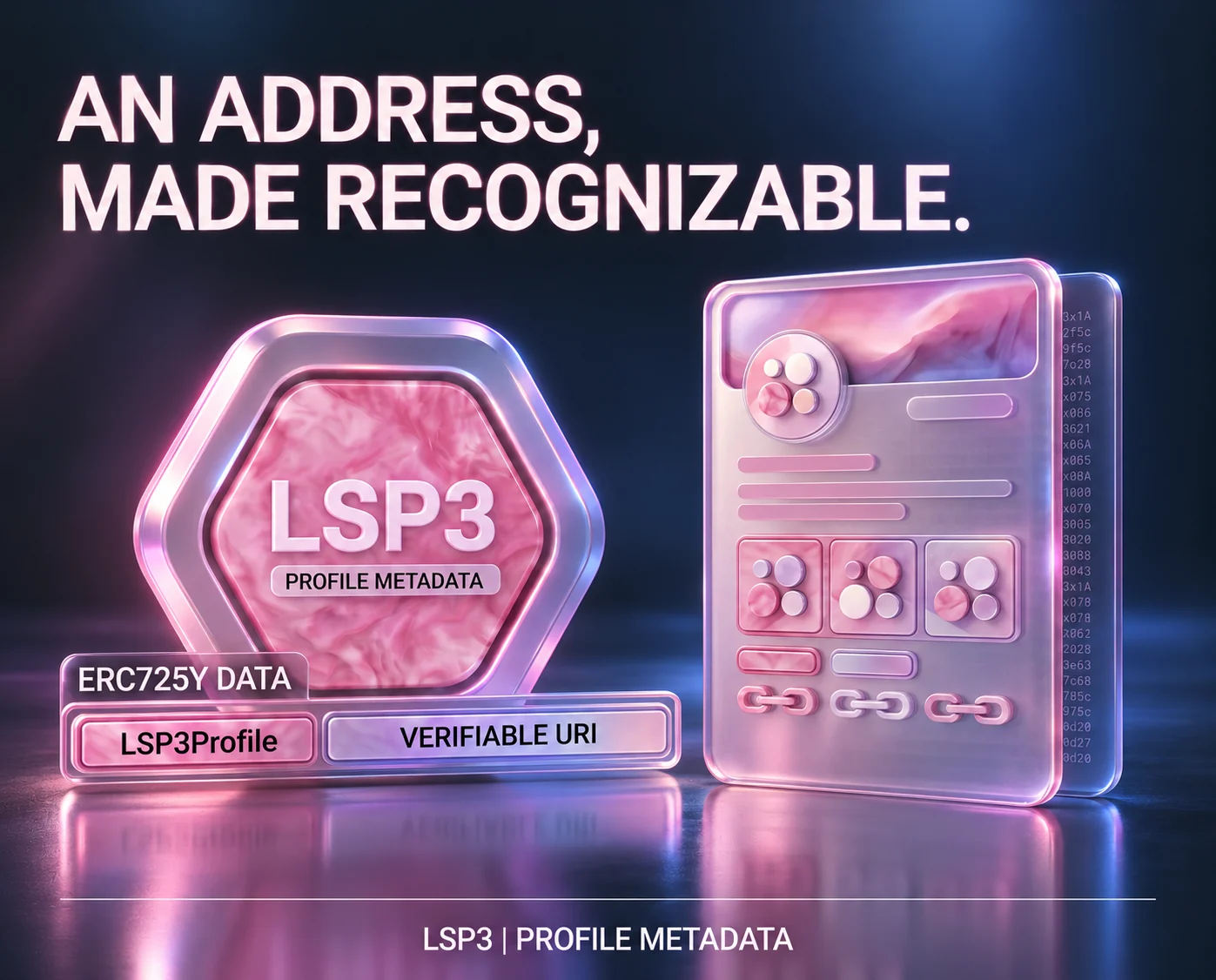
Data, not just a wallet
Your account stores data as well as assets. Add and update the information your agent and apps need.
ERC725Y and LSP3 Profile Metadata
ERC725Y gives the account a generic key-value store: any data key can hold a value. Controllers with permission write it; anyone can read it. LSP3 Profile Metadata is one use: the LSP3Profile key holds a verifiable link, a URI plus hash, to a JSON file with name, description, links, tags and images.
Stored data is public and kept separately on each network. Never store secrets in it.
ERC725Y documentation (opens in a new tab)ERC725Y Inspector (opens in a new tab)LSP-3 specification (opens in a new tab)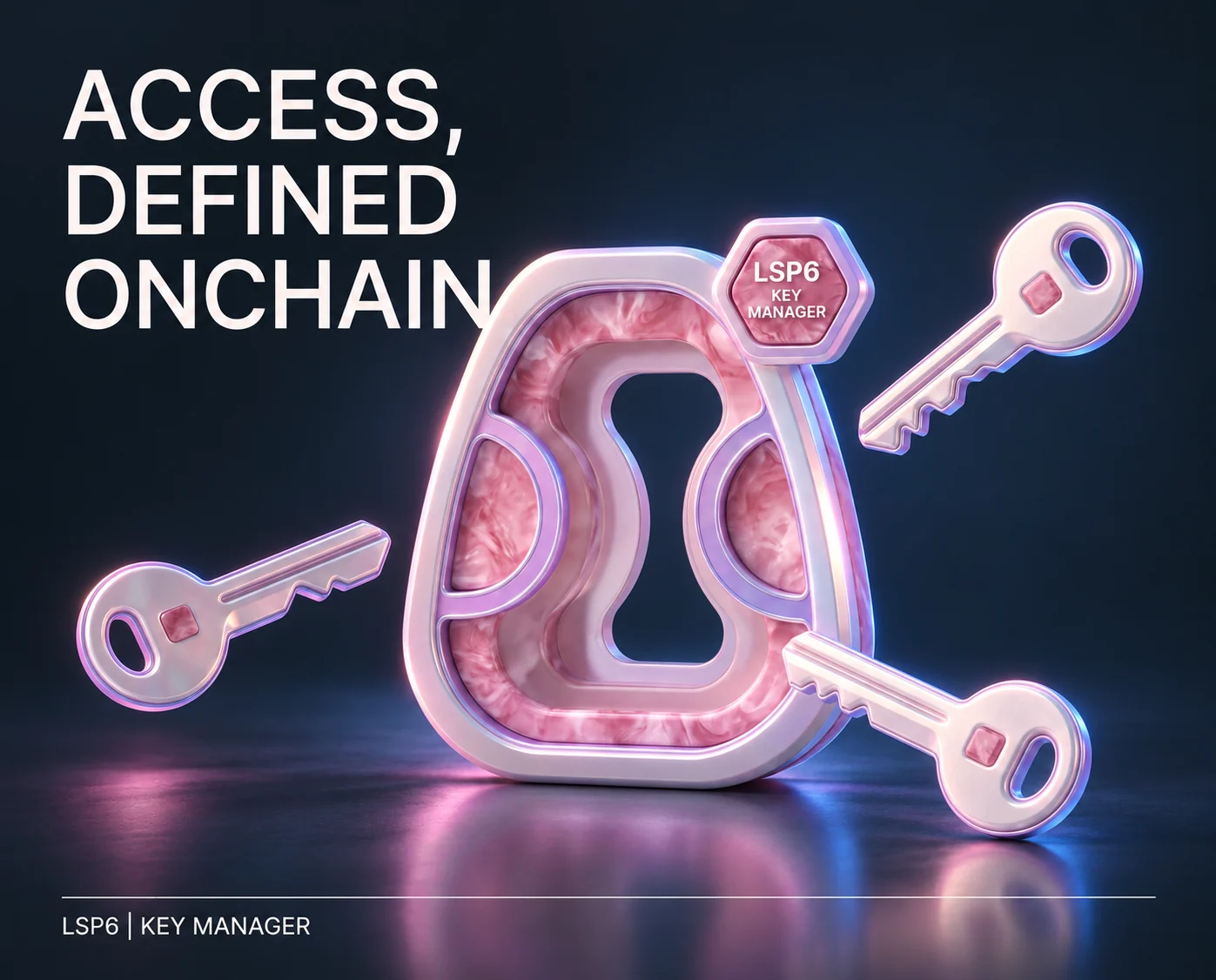
Separate keys and permissions
Your agent and anyone you add each use their own key, limited to the permissions you grant. Remove a key and the account keeps its address.
LSP6 Key Manager
Each controller address has its own permission set, which can be narrowed to allowed calls and data keys. A relayer only submits calls that a controller signed; it is never given control.
LSP6 has no built-in spending limit.
LSP-6 specification (opens in a new tab)
Notified when assets arrive
Your profile is notified when tokens or collectibles arrive and can react on its own, for example by adding them to its list.
LSP1 Universal Receiver
Token transfers call universalReceiver on the profile, which forwards the notification to the receiver delegate it has set.
This is a notification, not an approval. What happens next depends on the delegate, and assets that don't send a notification go unseen.
LSP-1 specification (opens in a new tab)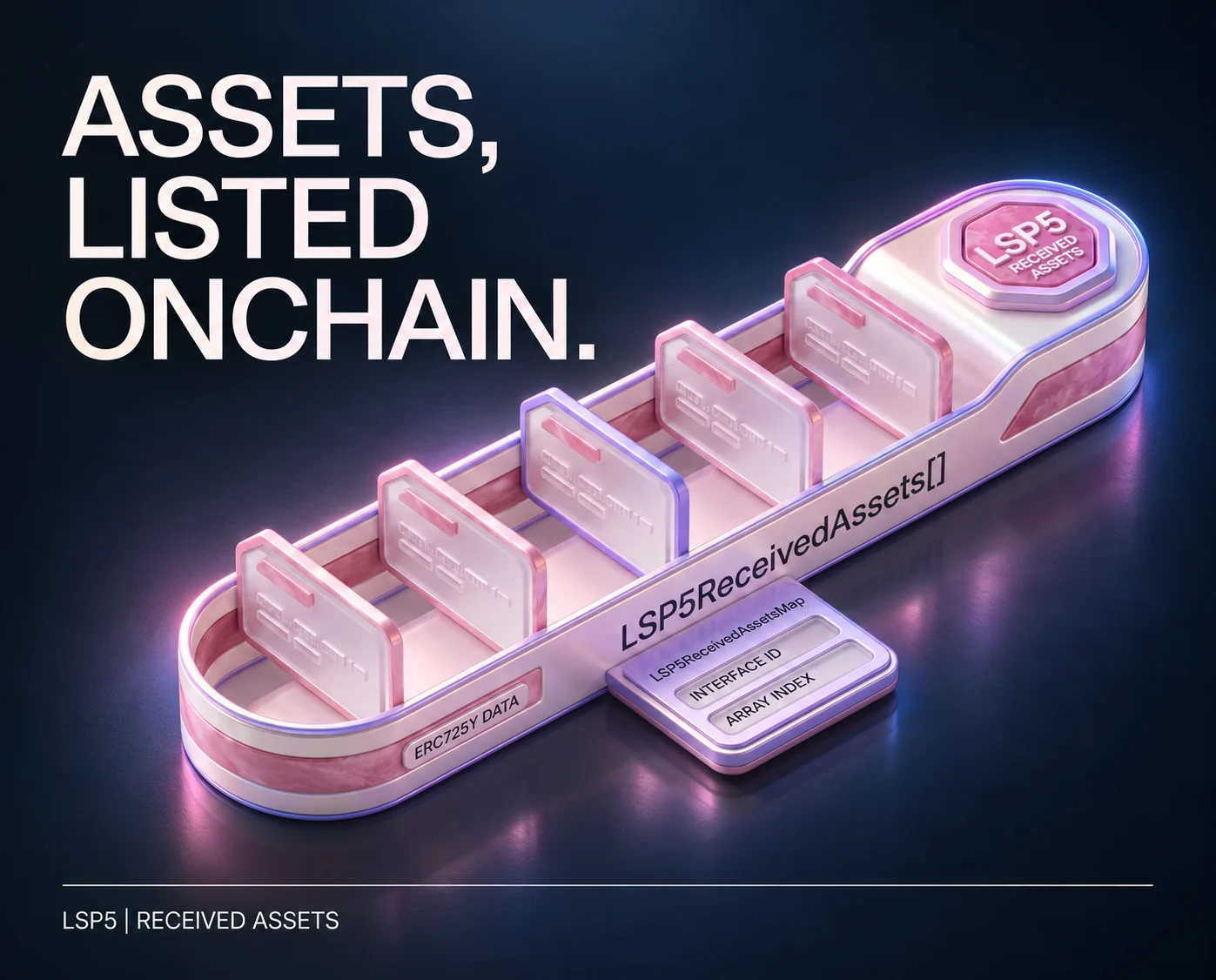
Holdings listed on the profile
Tokens and collectibles your agent receives can be listed on its profile, so apps read the same list.
LSP5 Received Assets
LSP5ReceivedAssets[] and its map store each asset's address, standard and position, usually kept up to date by the receiver delegate.
Each network keeps its own list, which does not show holdings on other networks.
LSP-5 specification (opens in a new tab)All 73 EVM networks with chain IDs
Mainnets (66)
- 0G16661
- ApeChain33139
- Arc5042
- Arbitrum One42161
- Avalanche C-Chain43114
- Base8453
- Berachain80094
- Blast81457
- BNB Smart Chain56
- Celo42220
- Chiliz88888
- Conflux EVM eSpace1030
- Core Blockchain1116
- COTI2632500
- Cronos25
- Degen Chain666666666
- Ethereum1
- Ethereum Classic61
- Etherlink42793
- Flare14
- Flow EVM747
- Gnosis100
- Gravity Alpha1625
- HashKey Chain177
- HyperEVM999
- Immutable zkEVM13371
- Ink57073
- Kaia8217
- Katana747474
- Kava EVM2222
- Lens232
- Linea59144
- LUKSO42
- Mantle5000
- MegaETH4326
- Mode34443
- Monad143
- Moonbeam1284
- Moonriver1285
- opBNB204
- Optimism10
- Plasma9745
- Plume98866
- Polygon137
- Pulsechain369
- Robinhood Chain4663
- Ronin2020
- Scroll534352
- Sei1329
- Somnia5031
- Soneium1868
- Sonic146
- Stable988
- Story1514
- Stratis Xertra105105
- Taiko Alethia167000
- Telos EVM40
- Tempo4217
- Unichain130
- World Chain480
- X Layer196
- Xai660279
- XDC Network50
- ZetaChain7000
- zkSync324
- Zora7777777
Testnets (7)
- Arbitrum Sepolia421614
- Base Sepolia84532
- Ethereum Hoodi560048
- Ethereum Sepolia11155111
- LUKSO Testnet4201
- Polygon Amoy80002
- zkSync Sepolia300
The chain configuration files list 75 entries (68 mainnets + 7 testnets). Astar EVM and WEMIX3.0 are configured but not in the deployment table, so they are not counted.
The count comes from the published deployment table, not from testing the agent setup on each of the 73 EVM networks.
Source: DEPLOYED_CHAINS.md at main commit 16ab244, checked 12 October 2026.